A field poppy picked at breakfast is often bare-stemmed by dinner. The petals lie on the table like crumpled tissue paper, the stem stands there with its little green crown, and the whole thing looks like a failure. It isn't. A poppy petal is one of the shortest-lived things in a garden, and once you accept the timetable you can work with it instead of fighting it. The reward is a flower that behaves like an event: here for a morning, gone by evening, and more beautiful for it.
Why a Poppy Petal Lasts a Day or Less
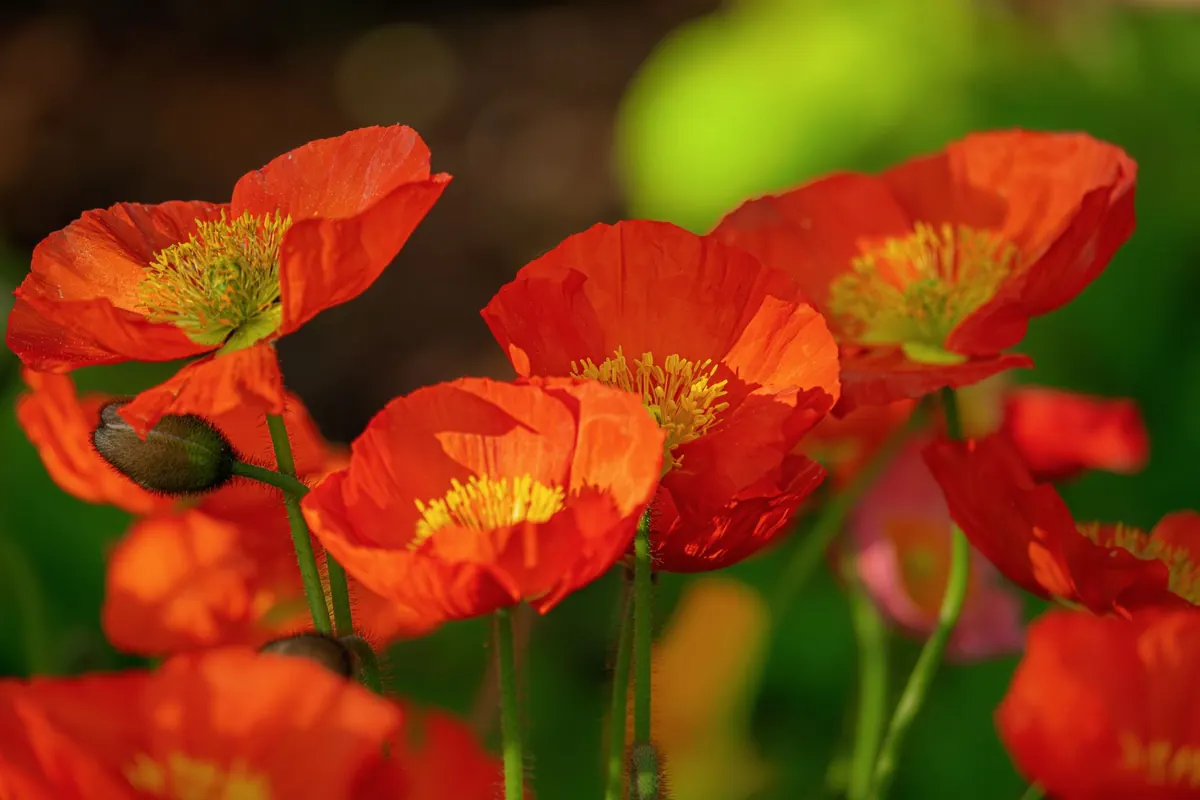
Most cut flowers protect themselves. A rose petal is thick, layered and lightly waxy; a carnation has enough substance to survive a warm car and a forgotten water change. Poppy petals have almost none of that. They are thin to the point of translucence, wide for their weight, and carry very little waxy covering to slow down water loss. Held up to a window, a single petal looks like stained glass — and it dries out about as quickly.
The petals have one job, and it is not decoration. They exist to flag down insects for a day or two, then get out of the way so the seed pod behind them can swell and ripen. Once pollination has happened, or once the flower has run out of time, the petals are simply ballast. They crease, go limp, and fall in a heap.
Conditions decide how long you get. Heat, dry air, direct sun and a draught will take a poppy from open to bare in a few hours. Cool, still, slightly humid air stretches things out. The type matters too: the scarlet field poppy (Papaver rhoeas) and the opium poppy (Papaver somniferum) are annuals with famously brief individual blooms, while Oriental poppies (Papaver orientale) are big perennials that keep pushing new buds, so the display continues even as each flower fades. Iceland poppies sit somewhere in between, with papery cups in apricot, cream and soft yellow.
No trick reverses any of this. What you can do is slow the countdown, cut at the right stage, and design around the fact that the flowers will move through their whole arc while your guests are still at the table.
What Happens Behind the Petals
Watch a poppy bud for a few days and you learn more than any guide can tell you. The nodding green bud is wrapped in two hairy sepals. When they split and drop, the crumpled petals inside unfurl, often within an hour or two — a bud can open in the time it takes to make coffee. The petals flare, the dark centre shows, and the flower is at its peak almost immediately.
Behind it sits the ovary, which becomes the seed capsule: the little pepper-pot head that stays long after the petals have gone. That capsule is the reason the plant bothers flowering at all, and it is also the reason a poppy stem is worth cutting. Fresh green pods last for weeks in water; dried ones last for months in a vase with nothing in it.
There is one more thing happening at the cut end. Poppies bleed a milky sap, and it seals the stem like a plug of setting glue. That is why a poppy dropped straight into a jar often flops within the hour, however deep the water. The sap is also mildly irritating to sensitive skin, so wear gloves if you are handling a lot of stems, and wash your hands afterwards.
Cut at the Right Moment
The best poppies for a vase are not the open ones. They are the buds that have just begun to show colour and have gone soft at the neck, with the head nodding over in a crook. Cut those and they will open in the vase over the next day or two, giving you the whole performance on your own schedule rather than the garden's.
Go out early, before the heat is on the stems, and take a bucket of water with you. Use a sharp knife rather than scissors — a clean angled cut takes up water better than a crushed one — and get each stem into the bucket within a few seconds of cutting. Fully open flowers are worth taking too, but treat them as same-day material: a lunch table, a bedside glass, a photograph you want to take that morning.
Seal the Stems Before You Do Anything Else
This is the step most people skip, and it makes the biggest difference. The aim is to stop the milky sap from sealing the cut end, so the stem can keep drinking.
There are two reliable ways to do it, both done immediately after cutting:
- Flame. Hold the cut ends over a candle or a lighter for about five to ten seconds, until the tips are blackened and sealed. Keep the flame well away from leaves and petals.
- Boiling water. Stand the bottom two or three centimetres of the stems in a jug of just-boiled water for about ten seconds. Keep the flowers well clear of the steam.
Either method works. Afterwards, move the stems straight into a bucket of cool, deep water and leave them somewhere cool and shaded. The difference between a seared stem and an unseared one is usually the difference between a poppy that stands up for two days and one that collapses by mid-afternoon.
Conditioning, Step by Step
Once the stems are sealed, give them a few hours to drink before you arrange anything. The routine is simple and worth doing properly.
- Strip the lower leaves. Poppy foliage is soft and wilts quickly, and any leaf sitting in water will rot and cloud it within a day.
- Fill a clean bucket with cool water and stand the stems deep, up to just below the buds.
- Leave the bucket somewhere cool, dim and draught-free for two to four hours, or overnight if you have the time.
- Arrange the stems, then top up the water daily and change it completely every day or two, rinsing the vase each time.
- Keep the finished arrangement away from radiators, sunny windowsills, open doors and bowls of ripening fruit — the ethylene that fruit gives off shortens flower life.
Recutting is best avoided once the stems are sealed, since a fresh cut reopens the sap channel. If a stem needs shortening, trim it and re-sear the end quickly.
Styling for a Short Season
Fleeting flowers ask for a different kind of arrangement. Instead of one crowded bouquet that will be bare in three days, think in single stems and small groups, placed so each bloom gets looked at. A row of small glass bud vases down the centre of a table, one poppy in each, is more striking than a massed vase — and as the petals drop, the row simply becomes a row of green pods, which is a look in itself.
Use the whole arc of the flower rather than pretending it will hold. Tight, furled buds give you anticipation. Open blooms give you a day of colour. Green seed pods give you the next few weeks, and dried pods give you the winter. A single arrangement can show all three stages at once if you cut a mix of bud, flower and pod, and that mix is far more interesting than a vase of identical open flowers.
Poppy stems are wiry and bend where you put them, which makes them generous to work with. Combine them with meadow company — grasses, cornflowers, nigella, wheat, a few seed heads — and the arrangement reads as a piece of field rather than a florist's construction. Colours do most of the work on their own: the flat scarlet of field poppies, the coral and deep burgundy of Oriental varieties, the pale crumpled cups of Iceland poppies.
Then plan for the fall. Poppy petals can stain, so put the vase on bare wood, a dark tray, a slate, or a linen runner you are not precious about, rather than on a pale cloth you love. Where the petals land, leave them. A drift of scarlet tissue on a wooden table, directly beneath the stem that shed it, looks intentional; the same petals scrubbed away in a panic look like a problem.
Making It Feel Deliberate: A Short Checklist
- Cut in the morning or evening, into water, with a sharp knife.
- Choose buds with colour showing and a soft, crooked neck for the longest vase life.
- Seal the ends by flame or boiling water straight away, then into deep cool water.
- Strip lower leaves and keep the water clean.
- Display in small, separate vessels so each bloom is visible.
- Plan on two or three days of petals, then enjoy the pods.
- Expect the open flowers to be same-day beauty, not week-long decoration.
None of this makes a poppy last like a chrysanthemum, and that is the point. The shortness is the character. Cut them at the right stage, seal the stems, keep the water cool and clean, and let the petals fall where they may — the arrangement will look less like a flower that gave up and more like a season passing through your room.
Photo: Ilo Frey / Pexels